
How to Play Lead Guitar: A Complete Beginner's Guide
If you’re someone who wants to learn how to play lead guitar, you probably remember the first time you watched your favorite guitarist step to the front of the stage and launch from rhythm guitar, into a powerful lead guitar solo, and thought to yourself—I want to do that. You’ve experienced the power of a guitarist bending a single note until it ached. Sliding up and down the neck, stringing notes together into a lick, a phrase, until it becomes a signature sound. The sound of someone playing lead guitar has the power to capture an audience and spark their imagination. A great guitar player can make playing look easy, so you get a guitar, go on YouTube, only to find, like most beginners, you don’t know where to start.
There are thousands of videos on YouTube now, but without a clear learning path designed and tailored for you, the process gets frustrating, and many would-be players give up before they ever get there. If you’ve already spent time learning open chords and basic strumming patterns, and you’re ready to start playing lead guitar — turning single notes into lead lines, learning riffs that build the foundation for guitar solos — this guide is designed for you. You’ll learn how to stretch beyond rhythm guitar and start playing lead solos, beginning with the five notes of the blues pentatonic scale, the core techniques that bring those notes to life, and how to develop your own signature sound. You’ll also learn the fundamentals of a practice routine that builds real skill instead of aimless noodling, and the mistakes that slow down almost every beginner.
If you want a taste of what this looks like, here’s a free instructional video from my YouTube channel: Don’t Just Practice, Learn How to Play!
None of this requires you to read music, know music theory, or own an expensive guitar. All it requires is an instrument that’s playable and in tune. People often ask me what the best kind of guitar is to learn on, and I always tell them the same thing: “The best guitar is the one you have in your hands.” From there, all you need is a little patience and a clear path forward — which is exactly what the rest of this guide gives you.
What Is Lead Guitar?
Why I Chose the MOTU M4 for Mobile Recording Studio
Lead guitar is the part of a song built from single notes rather than chords. A guitar solo is made up of guitar riffs, fills, and sometimes melodies, and these solos sit on top of everything else happening in the music. Great guitar solos have a theme, with a beginning, middle, and end. Iconic guitar solos have a hook, and those hooks create memorable guitar moments that everyone can sing along to, like the opening melody line from Lynyrd Skynyrd’s “Free Bird” and Jimi Hendrix’s “Purple Haze.” These solos are often the riff that opens the track; they can also be the fill that answers the singer’s line, with the anticipated extended guitar solos that round out the song and take listeners on a musical journey.
In a full band, lead guitar generally plays a melodic or improvisational role, while the other instruments — rhythm guitar, keys, bass, drums — hold down the harmony and groove underneath it. That doesn’t mean it ignores the chords; a good lead line is built around whatever’s happening harmonically underneath it. But the goal is different: rhythm guitar supports the song, while lead playing comments on it, decorates it, and sometimes becomes the most memorable part of it.
In a three-piece band, often referred to as a “power trio” — with examples like the Jimi Hendrix Experience, the core musicians of Led Zeppelin, Eric Clapton’s band Cream, and Stevie Ray Vaughan and Double Trouble — this style of guitar playing is riff-driven phrases that weave power chords and vocals, all leading to extended guitar solos, often referred to as guitar jams. This is where the chemistry between the band members is critical, because there are only three musicians: guitar, bass, and drums, creating a wall of sound.
Here’s a simple way to picture that relationship: rhythm guitar, bass, and drums are the road — steady, predictable, and always there underneath everything else. Lead guitar is the car driving down that road, free to speed up, ease off, swerve into a bend, or take an unexpected turn, all while staying connected to the road the whole time.
You don’t need a full band to play it, either. Plenty of guitarists build lead skills by playing over backing tracks, jamming with one friend on rhythm, or simply improvising over a chord progression they’ve recorded themselves using a guitar looper. What matters is the mental shift: instead of thinking “which chord goes here,” you start thinking “which notes and phrases sound good over this chord.”
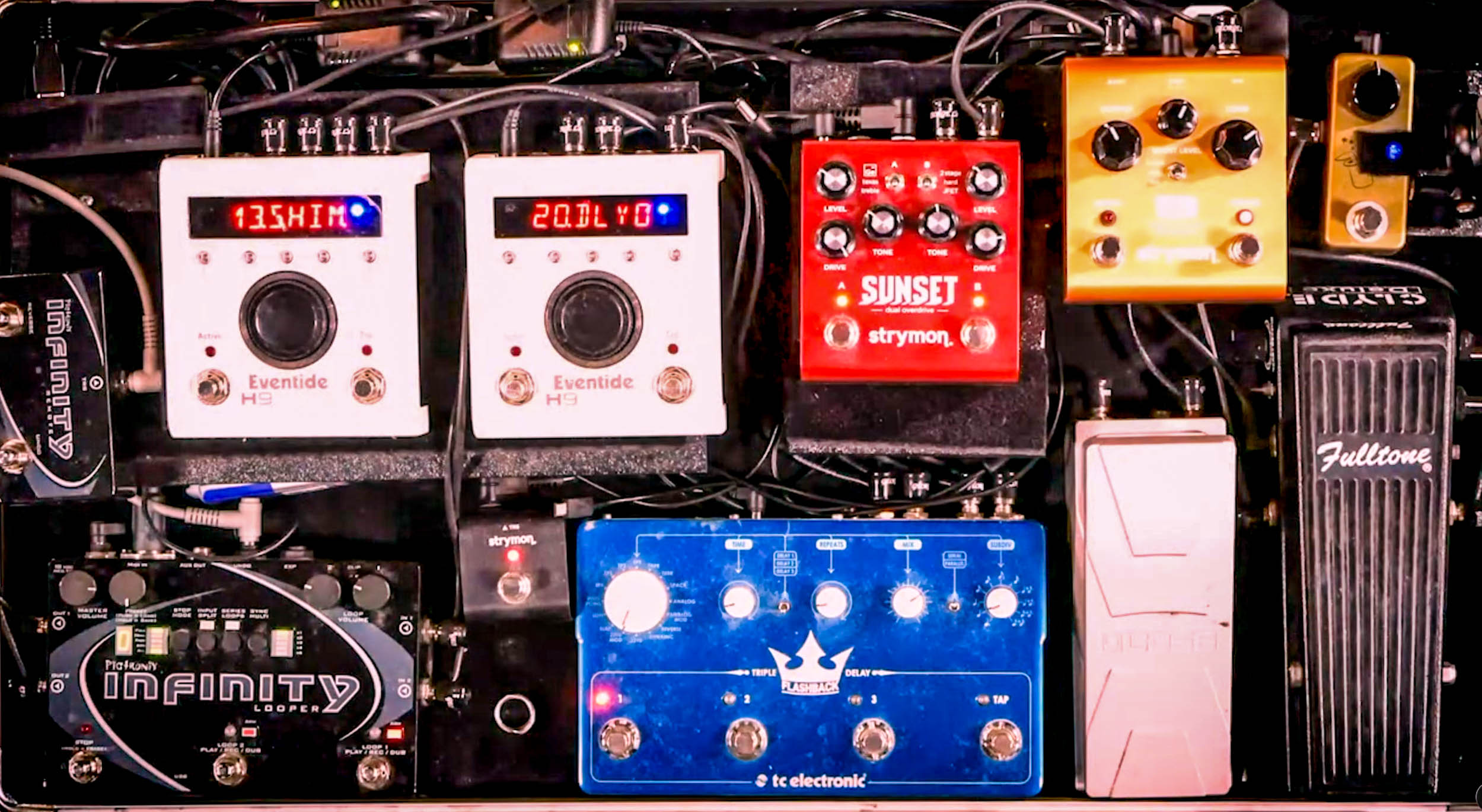
I spent the majority of my career fronting a power trio, and today I’ve expanded into the world of solo acoustic gigs, where I use a guitar looper and effects pedals to create the same experience for an audience using a different format.
That shift, from chords to single-note hooks and melodies, is really the whole definition of it, and it’s the foundation for everything else in this guide.
TrueFire Presents: Blues Grit
In this series, you will learn the fundamentals for how to play blues and rock guitar — from bar chords to pentatonic scales, and how to put them together.
TrueFire Presents: Focus On Blues-Rock Power Trio
In this series, I focus on what it takes to front a power trio. You’ll learn how to build a foundation that is cohesive, one that is built on powerful guitar riffs and power chords that support vocals and become the glue that holds the lead and rhythm sections together.
Lead Guitar vs Rhythm Guitar
It helps to think of lead and rhythm guitar as two different jobs on the same instrument, not two different skill levels. Rhythm guitar is the foundation, the chords, the strumming, the groove everyone else locks into. Lead playing sits on top of that foundation, delivering the hook or melodic material: riffs, licks, fills, and solos.
Here’s how the two compare directly:
Aspect | Lead Guitar | Rhythm Guitar |
Purpose | Carries melody, riffs, and solos | Provides harmony and groove |
Playing Style | Single-note lines | Chords and strumming patterns |
Core Techniques | Bends, slides, vibrato, hammer-on’s, pull-off’s, alternate picking, legato | Strumming patterns, chord transitions, muting |
Difficulty Curve | Technically demanding, especially for fast or expressive solos | Easier to start, but mastering timing and feel takes just as long |
Typical Gear | Lighter strings and lower action often preferred for bends and speed | Works well with almost any setup |
Musical Role | Stands out from the arrangement | Supports and anchors the arrangement |
Neither role is objectively “better” or “harder”, they demand different skills. A rhythm guitarist with rock-solid timing, good feel, and clean chord changes can be just as impressive as a lead player tearing through a solo. But if you’ve already got basic chords down and you’re craving the ability to play melodies and improvise, it’s the natural next step. Most experienced guitarists end up doing both, switching between the two roles depending on the song.

Why Learn Lead Guitar?
There are a handful of reasons players make the jump from rhythm to lead, and most of them come down to wanting more control over what they play:
Creativity. It lets you express your own musical ideas and develop your unique sound. Once you know the pentatonic scale and a handful of techniques, you can start making choices that are entirely your own.
Soloing. If you’ve ever wanted to take a solo when playing with other musicians, at a jam, in a band, or just recording something at home, that’s what makes it possible.
Improvisation. Lead playing trains you to think and react in real time rather than only replaying memorized parts, a skill that carries over into every style of music you play afterward.
Confidence. There’s a specific kind of confidence that comes from being able to step forward and play something that stands out, instead of always blending into the background.
Playing with others. Jam sessions, garage bands, and open mics almost always need someone who can trade licks, fill space, and solo over a progression. Those skills make you useful in exactly those moments.
Even if you never plan to play in a band, learning lead guitar changes your relationship with the instrument. You stop thinking only in terms of songs you’ve memorized and start thinking in terms of music you can create on the spot.
How to Play Lead Guitar (Step-by-Step)
Learning to play lead guitar starts by building fundamental skills. Finger exercises help you build muscle memory, dexterity, and hand strength. Pentatonic scales provide you with a roadmap for playing lead guitar. Once you’ve learned the roadmap, you’re ready to begin adding techniques, which lead to playing lead guitar. Here’s the order that tends to work best for beginners.

1. Start With Hand Position, Not Speed
Before you worry about playing fast, get your fretting hand into a position that lets you move efficiently. Keep your thumb roughly centered behind the neck, curve your fingers so you’re pressing with the tips, and aim to keep one finger per fret in whatever position you’re playing. Tension is the enemy here, if your hand or wrist feels tight after a few minutes, stop and reset. Almost every bad habit in lead playing traces back to unnecessary tension built in early.
2. Build a Clean Picking Motion
Alternate picking, strictly alternating downstrokes and upstrokes, is the picking foundation for almost all lead playing. Practice it slowly on a single string before applying it to scales: down, up, down, up, with a light, relaxed grip on the pick. Anchoring your picking hand lightly against the guitar’s body, rather than gripping hard, helps keep the motion small and efficient.
Note: It’s best practice to always start by using all down pics. This allows you to build the muscle memory needed before shifting into alternate picking.
3. Practice With Timing Before You Practice with Speed
This is the step beginners skip most often, and it’s the one that matters most. Play everything, scales, licks, bends, with a metronome or backing track before you try to play it fast. Speed that isn’t locked to a steady beat isn’t actually useful; it just sounds rushed. Slow and in time beats fast and sloppy every time.
4. Learn to Phrase, Not Just Play Notes
Phrasing is what separates a lead line that sounds like music from one that sounds like a scale exercise. Think of phrases the way you’d think of spoken sentences, they have a beginning, a shape, a place where they breathe, and a place where they land. Leave space between phrases. Repeat a short idea with a small variation. Answer one phrase with another, the way a singer answers their own line. This is a mindset as much as a technique, and it’s worth thinking about from your very first guitar solo attempt, not adding on later.
5. Add Vibrato
6. Add Bends
A bend is pushing or pulling a fretted string to raise its pitch, usually up to match a specific target note. The key skill is bending in tune, practice bending up to a target note, then check that note against the same note fretted normally, so your ear learns exactly how far to push. Start with half-step and whole-step bends before attempting anything larger.
7. Add Slides
A slide connects two notes by sliding your finger from one fret to another without picking again, creating a smooth, connected sound similar to how a voice glides between notes. Slides are especially useful for connecting phrases or sliding into a target note for emphasis.
Once these seven pieces are in place, hand position, picking, timing, phrasing, vibrato, bends, and slides, you have everything you need to start building your own lead vocabulary. Everything from here is about deepening each of these skills and layering scales and licks on top of them.

Finger Exercises
I teach my students three main finger exercises—each designed to help students build a connection with their instrument by developing muscle memory and proper technique. You cannot learn to play songs until you first develop a connection with your instrument and learn how to play the guitar.
Click here to download the free PDF: Finger Exercises 1, 2, 3
Pentatonic Scales
The pentatonic scale is a five-note pattern often referred to as the blue scale. This is the most common pattern that guitar players use when playing lead. You must first learn to play the pattern, then develop techniques, such as hammer ons and pull offs, vibrato, bending, and slides, to make these five notes come alive.
Click here to download the free PDF: Kelly Richey’s Pentatonic Roadmap

Essential Lead Guitar Techniques
With the fundamentals above in place, these are the specific building blocks worth focusing on next.
Scales. Scales give you a map of which notes will sound good over a given chord or key, so you’re not guessing. For beginners, the minor pentatonic scale is the single most useful scale you’ll play, it’s the backbone of blues, rock, and countless solos across genres, and it’s forgiving because nearly every note in it sounds “safe” against a matching chord progression. The blues scale (the minor pentatonic plus one extra “blue note”) adds tension and character. The major scale becomes useful once you want brighter, more melodic lines. Learn one scale shape thoroughly in one position before jumping to others, depth beats breadth early on.
Licks. A lick is a short, self-contained musical phrase, a few notes long, often just a beat or two, that you can learn, memorize, and later reuse or adapt. Licks are the vocabulary of soloing, the way phrases and idioms are the vocabulary of spoken language. Learning licks from players and styles you like is one of the fastest ways to develop your own soloing voice, because you start to internalize how phrasing and technique fit together.
Solos. A solo is simply a longer musical statement built from licks, scale runs, bends, and original ideas, strung together with intentional phrasing. You don’t need to compose an entire solo in advance, most great solos mix a few pre-learned ideas with genuine, real-time improvisation.
Alternate picking. Covered above as a fundamental, but worth re-emphasizing: consistent down-up alternate picking is what most fast, articulate lead lines are built on. It’s worth isolating in practice on a single note before applying it to full scale runs.
Legato. Legato playing uses hammer-ons and pull-offs to connect notes smoothly, with far fewer pick strikes than alternate picking. It produces a slippery, fluid sound that’s common in rock and fusion lead playing. Most advanced players blend legato and alternate picking rather than relying on just one.
Hammer-ons and pull-offs. A hammer-on sounds a note by tapping a fretting finger down onto the string without picking it. A pull-off does the reverse, you pluck the string with a fretted finger as you lift it off, sounding the lower note underneath. Together, these are the core of legato playing, and they’re essential for fast, smooth-sounding runs that don’t rely on picking every single note.
String bending. Beyond the basic mechanics covered earlier, string bending has real nuance: bending up to a note and holding it, bending and releasing, bending one string while another rings underneath it, and “pre-bending” a string before you even pick it. These variations are where much of the emotional character in blues and rock soloing comes from.
Vibrato. As mentioned above, vibrato varies by style, a wide, aggressive vibrato is common in blues and hard rock, while a subtler, faster vibrato shows up more in cleaner or more melodic playing. Listening closely to players in the style you want to play is the fastest way to develop vibrato that fits.
Put together, scales give you the notes, licks and solos give you the vocabulary, and hammer-ons, pull-offs, bends, slides, and vibrato give you the expression that makes it all sound human instead of mechanical.

Best Practice Routine
Progress rewards consistency far more than long, occasional sessions. A focused 30–45 minutes a day will get you further than a single three-hour session once a week. Here’s a routine that covers everything above without overwhelming you:
- Warm-up (5–10 minutes). Simple chromatic finger exercises 1, 2, 3 gets your hands moving and check that you’re not carrying tension from earlier in the day.
- Scale practice (10 minutes). Pick one scale shape, start with minor pentatonic, and play it slowly with a metronome, focusing on clean, even notes rather than speed.
- Technique drills (10 minutes). Using your pentatonic scales, rotate through bends, hammer-ons/pull-offs, and alternate picking exercises. Isolating one technique at a time builds skill faster than practicing everything at once.
- Applied playing (10–15 minutes). Put on a backing track, there are thousands of free ones online in nearly every key and style, and actually play, using the scale and techniques you just practiced, but in a musical context instead of an exercise.
- Free improvisation and recording (5 minutes). Record yourself improvising, even briefly. This is one of the most underused tools in guitar practice, hearing yourself back reveals timing issues, favorite licks you overuse, and phrasing habits you can’t hear in the moment.
If 30–45 minutes isn’t realistic on a given day, 10–15 focused minutes still beats skipping practice entirely. The goal is a daily habit, not a perfect session.
YouTube Channel: Don’t Just Practice, Learn How to Play
Common Beginner Mistakes
A handful of mistakes show up in almost every beginner’s playing. Catching them early saves months of relearning later.
Practicing fast before practicing accurately. Speed is a byproduct of clean, repeated, in-time practice, not something you can force directly. Chasing speed first tends to bake sloppy technique in at a high tempo, which is much harder to undo than building speed slowly from a clean foundation.
Skipping the metronome. It feels slower and less exciting than playing freely, but timing is one of the most noticeable things listeners react to, more than raw speed or note choice. Metronome practice, even for a few minutes a day, pays off quickly.
Learning scale shapes without learning to hear them. It’s possible to memorize a pattern on the fretboard without ever training your ear to recognize how it sounds. Sing or hum the notes as you play them occasionally, it builds a connection between what you play and what you hear that muscle memory alone doesn’t.
Gripping the neck too tightly. Tension in the fretting hand, wrist, or shoulder is one of the biggest hidden speed limiters. If your hand feels tired or sore quickly, that’s almost always a tension problem, not a strength problem.
Never recording yourself. It’s uncomfortable at first, but a quick phone recording reveals things, timing slips, overused licks, thin-sounding phrasing, that are nearly impossible to notice while you’re playing.
Comparing your progress to advanced players. Watching a great guitarist and comparing it to your week-three playing is comparing a finished result to a rough draft. Compare your playing to your own playing from a month ago instead.
Playing notes without leaving space. New lead players often fill every available beat with notes. Space is part of phrasing, some of the most memorable guitar lines are memorable partly because of what’s left out.

Acoustic vs Electric Lead Guitar
Techniques transfer between acoustic and electric guitar, but the two instruments respond differently, and it’s worth understanding the differences before deciding where to focus.
Factor | Acoustic Lead Guitar | Electric Lead Guitar |
Tone | Warm, natural, less sustain | Wide tonal range, longer sustain, shaped by amp and effects |
String Tension | Higher tension, thicker strings, bends take more finger strength | Lighter strings and lower tension, bends and fast runs are easier |
Amplification | Usually played unplugged or lightly amplified | Requires an amp; opens up distortion, delay, reverb, and other effects |
Common Styles | Fingerstyle solos, singer-songwriter leads, unplugged blues | Rock, blues, metal, fusion soloing |
Learning Curve | Builds strong finger strength and precision early | More forgiving on the fingers; often easier to start bending and playing fast |
Neither is objectively better for learning to solo, plenty of great lead players started on acoustic, and plenty started on electric. If your only guitar right now is an acoustic, you can absolutely start developing real technique on it; you’ll just build finger strength a little faster and may find big bends more demanding until that strength catches up. If you’re choosing between the two specifically for lead playing, electric guitar’s lighter strings and lower action make early bends, fast runs, and long practice sessions somewhat easier on your hands.
Choosing the Right Guitar
If you’re shopping for a guitar specifically to develop lead technique, a few things matter more than brand name or price tag:
- Setup matters more than the instrument itself. A guitar with high action, strings sitting far from the fretboard, makes bending, fast playing, and general comfort noticeably harder, no matter how good the guitar is otherwise. A proper setup, adjusting the action, intonation, and neck relief, makes an inexpensive guitar feel dramatically better to play.
- Lighter strings help early on. If you’re on electric guitar, lighter-gauge strings make bending and fast technique easier while you’re building finger strength. You can move to heavier strings later if your style calls for it.
- Neck width and scale length affect comfort. If your hands are smaller, a narrower neck can make a real difference in comfort, especially for bends and stretches.
- Try before you commit, if you can. Feel varies a surprising amount between individual guitars, even within the same model. Playing a few options in person, or reading detailed reviews if you’re buying online, is worth the extra effort.
- You don’t need to spend a lot to start. A well-set-up beginner or intermediate guitar will teach you everything you need for the first year or more of lead playing. Upgrading later, once you know what you actually want from an instrument, is usually a better use of money than overspending up front.
How Long Does It Take to Learn Lead Guitar?
This is one of the most common questions, and the honest answer is that it depends far more on consistency than on talent. As a rough guide, with regular practice of 20–30 minutes most days:
- A few weeks to a couple of months: comfortable playing a single scale shape cleanly, with basic bends and simple licks
- Six months to a year: trading simple licks and short solos over familiar chord progressions with reasonable timing
- One to two years: confidently soloing in a jam or band setting, with a recognizable personal style starting to emerge
- Ongoing, for as long as you play: even advanced and professional players continue developing technique, vocabulary, and phrasing, it doesn’t really have a finish line
The biggest factor by far is consistency. Twenty focused minutes a day, most days of the week, will get you further in six months than an hour once a week will get you in a year. Talent affects how quickly specific techniques click, but it doesn’t replace the repetition needed to build real muscle memory and timing, that part is the same for everyone.
Should You Take Professional Lead Guitar Lessons?
Plenty of guitarists teach themselves from videos, tabs, and trial and error, and it’s entirely possible to make real progress that way. But there are specific things a good instructor does that self-teaching struggles to replicate:
- Real-time correction. An instructor can spot tension, picking inefficiencies, or timing issues the moment they happen, habits that are much harder to notice in yourself and much harder to undo once they’re built in.
- A tailored path. Rather than following a generic video series, a private instructor can build a practice plan around the style you actually want to play, whether that’s blues, rock, metal, or something else entirely.
- Accountability. Regular lessons create a natural structure that keeps practice consistent, which, as covered above, is the single biggest factor in how quickly you improve.
- Faster troubleshooting. When something isn’t working, a bend sounds off, a lick won’t come together, an instructor can usually diagnose the specific issue in minutes rather than the hours of guesswork it might take alone.
For students who want that kind of structure, in-person lessons in Milford, Ohio, alongside flexible online lessons over video call, give you the choice of hands-on instruction or the convenience of learning from home, whichever fits your schedule best.
Lessons aren’t the only path forward, and plenty of self-taught players get there eventually. But if you want to avoid ingraining bad habits early and want to progress efficiently, working with an instructor, in person or online, is one of the most reliable ways to shortcut months or years of trial and error.
Frequently Asked Questions
What is lead guitar?
Lead guitar refers to playing melodic, single-note lines, solos, riffs, licks, and fills, rather than strumming chords. It’s the part of a song that typically carries the melody or stands out from the underlying harmony.
Is lead guitar harder than rhythm guitar?
Not exactly harder, different. It demands skills like bending, fast picking, and phrasing, while rhythm guitar demands rock-solid timing and clean chord transitions. Both take real time to master well.
Can beginners learn lead guitar?
Yes. While it’s common to start with rhythm guitar and basic chords, there’s no rule requiring it, plenty of beginners start learning simple lead lines and scale shapes very early, especially with guidance.
How long does it take to learn lead guitar?
Basic comfort with a scale and simple licks typically takes a few weeks to a couple of months of consistent practice; confident soloing in a band or jam setting is usually a one-to-two-year journey. See the section above for a fuller breakdown.
Do I need an electric guitar to play lead guitar?
No. Lead guitar techniques work on both acoustic and electric guitar. Electric guitar’s lighter strings and lower action make bends and fast playing somewhat easier while you’re building technique, but the acoustic version is a legitimate, well-developed style in its own right.
Can I learn lead guitar online?
Yes. Online lessons, whether one-on-one with an instructor over video call or through structured video courses, can teach the technique effectively, especially when paired with regular feedback and a metronome or backing track for practice.
What scales should beginners learn first?
The minor pentatonic scale is the standard starting point for most styles, especially blues and rock, it’s forgiving, widely used, and directly transferable to countless songs. The blues scale and major scale are natural next steps.
How often should I practice lead guitar?
Short, daily practice, even just 20–30 minutes, produces better results than occasional long sessions. Consistency matters more than session length for building the muscle memory and timing this depends on.
What's the best way to improve at lead guitar?
Practice with a metronome or backing track rather than in isolation, record yourself regularly to catch issues you can’t hear in the moment, and focus on phrasing and timing at least as much as speed and technique.
Are private lead guitar lessons worth it?
For most beginners, yes. An instructor catches technique issues early, tailors practice to your goals, and shortens the trial-and-error period significantly. Self-teaching can work too, but usually takes longer and risks ingraining habits that need correcting later.
Do I need to know music theory to play lead guitar?
No, not to get started. Learning one scale shape and a handful of techniques is enough to begin playing real lead lines. Basic theory, like knowing which notes belong to which chord, becomes more useful as you advance and want more control over your note choices.
What's the difference between a lick and a solo?
A lick is a short, self-contained phrase, often just a few notes long. A solo is a longer musical statement built from licks, scale runs, and original ideas strung together with intentional phrasing.
Do I need to read sheet music to learn lead guitar?
No. Most guitarists learn lead guitar through tablature, scale diagrams, and by ear rather than standard sheet music, and plenty of professional players never learn to read music fluently.
Conclusion
Lead guitar isn’t a separate instrument from the one you already know how to play, it’s a different way of using it. Every technique in this guide, from scales and bends to vibrato, phrasing, hammer-ons, and pull-offs, builds on the same guitar and the same hands you already have. What changes is how you practice and how patient you’re willing to be with the process.
Start small: one scale shape, one technique at a time, a metronome running in the background, and a few minutes of recording yourself along the way. Progress here comes from repetition more than raw talent, and it rewards consistency far more than intensity.
If you’re ready to build these skills with structured, hands-on guidance, in-person lead guitar lessons in Milford, Ohio, or flexible online lessons, can help you get there with fewer wrong turns and a lot more confidence along the way. Reach out today to book your first lesson and take the next step toward playing lead guitar with real skill and expression.
